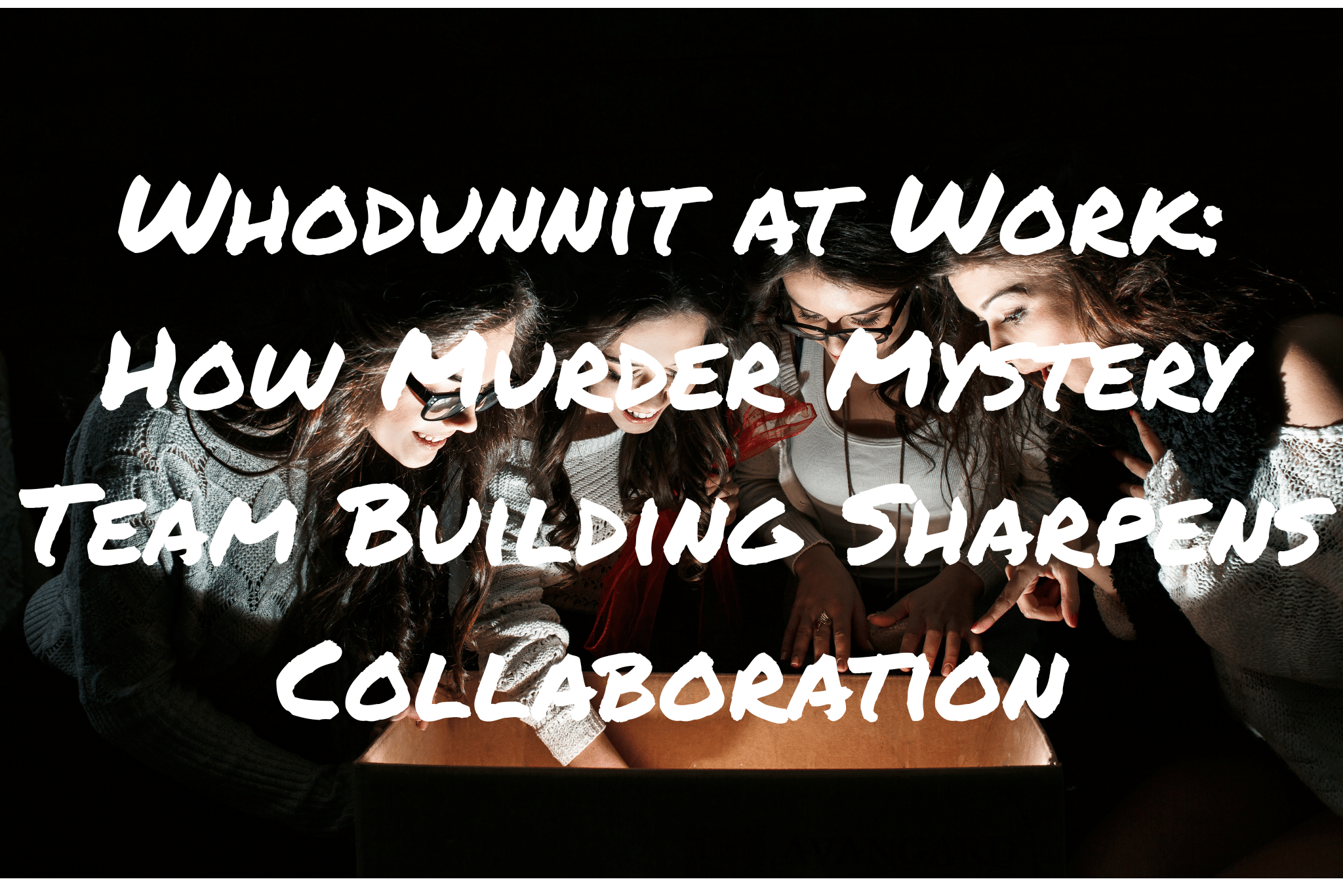
Murder mystery team building sounds like pure entertainment, and it is enormous fun, but that is only half the story. Underneath the costumes, red herrings, and dramatic reveals sits one of the most effective collaboration workouts a team can do.
To crack the case, people have to share information, listen properly, challenge each other’s assumptions, and reach a decision together under time pressure. Those are the exact skills that make or break a team back at the desk. This is a look at why the whodunnit format works so well, what it actually builds, and how to run one that lands.
What a Murder Mystery Event Actually Involves
For anyone who has not done one, the format is simple to grasp and endlessly variable in practice. The group is dropped into a fictional scenario, usually a crime that needs solving, and given a mix of clues, character roles, suspects, and evidence to work through.
Some versions are theatrical, with actors playing suspects the team can interrogate. Others are more like a structured puzzle, with the group piecing together timelines, motives, and alibis from a pack of evidence. Either way, the team has to work as a unit to reach the solution before time runs out.
A good event scales from small groups to large ones, splitting big teams into rival investigation units who compare theories at the end. The theme carries the energy, but the collaboration is what makes it stick long after the culprit is unmasked.
The Communication Skills It Quietly Builds
The first thing a whodunnit demands is communication, and not the polite, surface kind. To solve the case, people have to actually share what they know, because the clues are deliberately scattered so no single person holds the full picture.
This forces a specific behaviour that teams often lack. Someone has to speak up about the odd detail they noticed. Someone else has to listen carefully enough to connect it to another clue. The whole group has to build a shared understanding out of fragments.
When a team practises this in a playful setting, the habit carries back to real work, where scattered information and partial views are the norm. Research on the secrets of great teamwork highlights open communication and shared understanding as central to team performance, which is exactly what the format drills.
The team building experience sticks precisely because it rehearses a real workplace skill rather than an abstract one. A team that learns to pool what it knows over a fictional case tends to do it more readily over a real project.
How Deduction Mirrors Real Problem-Solving
Solving a mystery is, at heart, structured problem-solving, and it maps neatly onto how good teams tackle real challenges. The group faces ambiguity, competing theories, and incomplete data, then has to reason its way to a confident decision.
Along the way, people have to test assumptions rather than jump to the obvious answer. The first suspect is rarely the culprit, and teams that leap to conclusions get it wrong.
Learning to slow down, weigh the evidence, and change your mind when a new clue appears is exactly the discipline that separates strong decision-making from weak. Murder mystery team building rewards the team that reasons carefully over the one that shouts loudest.
It also surfaces different thinking styles. The detail-spotter, the big-picture theorist, and the sceptic who questions everything all prove their worth, and the team learns to value each.
The MIT-led research on the new science of building great teams found that communication patterns in shared activity predict success more than individual brilliance, which a group investigation puts straight to work.
Some of the sharpest team building game formats work on this principle, showing a group that its mix of minds is a strength rather than a source of friction. That lesson outlasts the event itself.
Building Trust Through Shared Discovery
There is a particular kind of bonding that comes from solving something together. The shared “aha” moment when the pieces click, the collective groan at a dead end, and the triumph of naming the culprit all create memories that tie a team together.
Because everyone is equal in front of the mystery, hierarchy fades fast. The most junior person might spot the clue that cracks the case, and the senior manager might follow a red herring down a blind alley.
That levelling is powerful, because it lets people see each other differently, freed from job titles and org charts. Trust grows when colleagues discover, together, that they can rely on each other’s instincts.
This is where the format earns its keep as more than entertainment. A partner like Zing Events can pitch the difficulty and tone so the challenge feels exciting rather than stressful, which keeps the trust-building front and centre.
It is a big part of why team building exercises work at all, since the payoff shows up afterward, when people who solved a case together approach real problems with a little more faith in one another.

Running a Whodunnit That Actually Lands
A murder mystery only delivers if it is run well, and a few choices make all the difference between a memorable event and a confusing one. Getting these right is what turns a fun idea into a genuine collaboration workout.
Match the format to your group first. A theatrical, actor-led version suits outgoing teams who enjoy playing along, while a puzzle-led evidence pack suits quieter, more analytical groups. Scale it properly, splitting larger teams into investigation units so nobody spectates.
Pitch the difficulty so the case is solvable but not obvious, since a mystery that is too easy bores people and one that is too hard frustrates them. Build in a proper debrief at the end, where the group talks through how they reached the answer, because that reflection is where the collaboration lessons land.
Well-structured team building event formats treat the reveal as the beginning of the conversation, not the end. Done thoughtfully, the whodunnit becomes a story the team retells for months.
Frequently Asked Questions (FAQs)
1. How Many People Do You Need for a Murder Mystery?
They scale well, from small groups of six or eight up to large events of a hundred or more. Bigger groups split into competing investigation teams who compare theories at the end. The format flexes to the numbers, which is part of why murder mystery team building suits so many company sizes.
2. Is It Suitable for Quieter or More Introverted Teams?
Yes, especially the puzzle-led versions built around evidence rather than performance. Quieter members often excel at the careful deduction the format rewards, spotting details others miss. Nobody is forced to act or perform, so introverts contribute through analysis rather than theatrics.
3. How Long Does an Event Usually Take?
Most run between two and three hours, which is long enough to build tension and reach a satisfying reveal without dragging. Add time for a meal or social wind-down if you want to make an afternoon or evening of it, and build in a short debrief at the end.
4. Does It Actually Build Workplace Skills or Is It Just Fun?
Both. The fun is what makes people engage, but the format genuinely rehearses communication, information-sharing, and collaborative decision-making under pressure. The debrief is what converts the experience into lasting lessons, so do not skip it if the developmental payoff matters to you.
5. Indoor or Outdoor, and Does the Setting Matter?
Most murder mysteries run indoors, which suits the format’s focus on clues, characters, and discussion. The setting matters less than the quality of the scenario and facilitation. A characterful venue adds atmosphere, but a well-written case works even in a plain meeting room.
Murder mystery team building proves that the best collaboration practice rarely feels like practice at all, because a team that learns to share clues, test theories, and trust each other over a fictional case carries every one of those habits straight back to real work.