Picture two versions of the same office. In one, corporate games mean grim competition, sharp elbows, and someone sulking because their team lost. In the other, they mean people on their feet yelling encouragement, strangers from different departments high-fiving, and the quietest person in the room getting cheered on like a hero.
Same games, wildly different outcomes. The gap between the two comes down to design. Games can pull a team apart or knit it together, and the difference is not the activity itself but the psychology built into how it runs. Here is how to land firmly in the second office.
Why Some Games Divide and Others Unite
Competition is a double-edged tool. Handled badly, it turns colleagues into rivals, breeds resentment, and leaves losers feeling small. Handled well, it does the opposite, giving people a shared thrill and a reason to lift each other up. Understanding which way it tips is the whole skill.
The dividing version usually has high stakes, individual winners, and consequences that linger. Someone’s ego takes a hit, a rivalry sours, and the mood curdles. The uniting version keeps stakes light, rewards the group over the individual, and makes the playing itself the point rather than the winning.
Corporate games that turn colleagues into cheerleaders are engineered for the second pattern from the ground up. Everything that follows is about tilting the design that way.
Design Principle One: Make People Depend on Each Other
The fastest way to turn rivals into cheerleaders is interdependence. When people need each other to succeed, they naturally start rooting for each other rather than against.
Games where one person cannot win alone force this. Relay formats where every leg counts, build challenges where different skills combine, and puzzle rooms where the group only cracks it together all make teammates invested in each other’s success.
The loud member needs the quiet observer’s eye. The planner needs the doer’s hands. Suddenly people are cheering because their own outcome depends on their colleague nailing it.
This mirrors what the research shows. A piece on the secrets of great teamwork points to shared goals and clear complementary roles as the biggest drivers of team performance. Corporate games built on interdependence recreate exactly that dynamic in a compressed, playful form, which is why the cheering feels so natural.
Design Principle Two: Reward the Team, Not the Individual
Where the scoreboard points, the energy follows. The second principle is to structure rewards around collective achievement rather than individual glory, because that decides whether people compete against colleagues or alongside them.
Team scoring, shared prizes, and celebrating group milestones all steer the mood toward mutual support. When the team wins together, everyone has a reason to cheer everyone else on.
Contrast that with a single-winner format, which quietly pits people against their own colleagues and leaves most of the room as losers. Even friendly individual competition can nudge egos into the wrong gear.
The subtle move is to make the group’s collective effort the headline and any individual moments a bonus. Corporate games that celebrate the team turn every good play by any member into a shared win, and that is what gets people on their feet for each other.
Formats designed around collective wins sit at the heart of the best team building game ideas, precisely because they build support rather than rivalry.
Design Principle Three: Give Every Player a Moment
Cheerleaders are made when everyone gets a chance to shine, not just the naturally athletic or outspoken. The third principle is designing games so every personality and ability type has a moment where the team needs them.
The trap is games that only reward one kind of person. If success comes down purely to speed or strength, half the room checks out and the quieter members become spectators to their own event. The fix is variety within the game. A challenge that mixes physical tasks with mental puzzles, creative rounds, and strategic decisions gives different people their moment in turn.
When the strategist cracks the puzzle that the sprinters could not, the whole team learns to value them, and the cheering spreads to people who rarely get it. Research on the cognitive benefits of play notes that varied, playful formats draw out different strengths and lift the whole group.
This inclusivity is what makes corporate games genuinely unite a group rather than reinforce an existing pecking order. Plenty of accessible work team building games are built this way, with multiple routes to contribute so nobody sits on the bench.
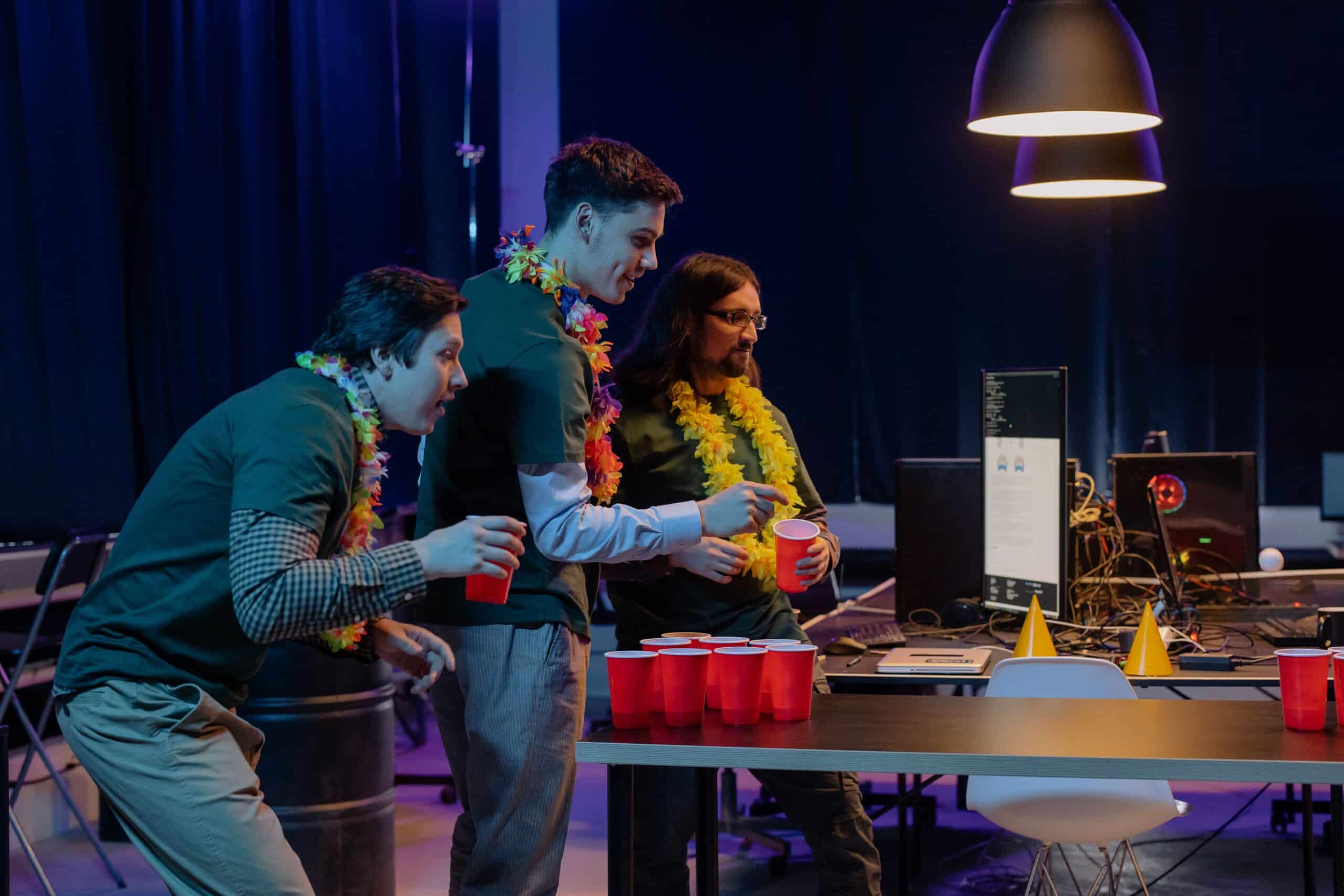
Design Principle Four: Keep the Stakes Light
The final principle is tone. The same game can feel like a bit of fun or a high-pressure trial depending entirely on how the stakes are framed, and light stakes are what keep the cheering warm rather than cutting.
When losing carries no real cost, people relax and enjoy the play. They laugh at their mistakes, celebrate the other team’s good moves, and stay generous throughout. Pile on real consequences, a prize that matters too much, or leadership watching to judge, and the mood tightens instantly. Egos come out, generosity vanishes, and the cheerleading dies.
Setting the tone is a deliberate act. Frame the games as a laugh, keep leaders playing rather than judging, and make it clear the point is the shared experience, not the trophy.
A partner like Zing Events can help pitch the competitive edge just right, sharp enough to be exciting but light enough to stay friendly. The real benefits of a games day show up when people leave having lifted each other up, not having beaten each other down.
Watch the room as you go, too. If you notice the mood tightening, one team getting frustrated, or a few people going quiet, that is your cue to lighten things. Switch to a more collaborative round, drop the scoreboard for a game or two, or simply crack a joke that resets the temperature.
A good host reads these signals and adjusts on the fly rather than ploughing through a fixed running order. The games are a means to an end, and the end is a team that likes each other a little more by the time the last whistle blows.
Bringing the Cheerleaders Out
Put the four principles together and the transformation is reliable. Build in interdependence so people need each other. Reward the team so wins are shared. Give every player a moment so everyone gets cheered. Keep the stakes light so the mood stays generous. Design for all four and colleagues turn into cheerleaders almost every time.
The reassuring part is that none of this depends on budget or novelty. A simple set of well-designed corporate games will out-perform an expensive, badly-framed one every time, because the psychology does the heavy lifting rather than the price tag.
Get the design right and you do not just run a games day, you change how the team sees and supports each other long after the scores are forgotten.
That shift is the whole point. When people have cheered each other on, celebrated a teammate’s unexpected win, and laughed through a shared near-miss, they carry a little of that generosity back to their desks. Meetings loosen up. People ask for help more readily.
The person who cracked the puzzle gets a nod of respect they did not have before. None of it is complicated, and none of it requires a big spend. It just requires designing corporate games with the four principles firmly in mind, so competition pulls the team together instead of prising it apart.
Frequently Asked Questions (FAQs)
1. Do Competitive Games Damage Team Morale?
Only when designed badly. Competition with light stakes, team-based rewards, and roles for everyone builds morale rather than harming it. The problems come from high-stakes, individual-winner formats. Framed as friendly fun with the group as the unit, competition brings people together.
2. How Do I Include Less Competitive Team Members?
Choose games with multiple ways to contribute, mixing physical, mental, creative, and strategic elements. That gives quieter or less sporty members a genuine role and a moment to shine. Avoid formats where success rests on a single ability, which sidelines everyone else.
3. What Group Sizes Work for Corporate Games?
Most scale from around ten people upward. Below ten you lose the variety of personalities that makes the dynamics fun. For very large groups, split into smaller teams and run stations or rounds, then reconvene, so everyone stays actively involved throughout.
4. Should Leaders Take Part?
Yes, as players rather than judges. Leaders joining in as equals levels the room and keeps the stakes light. Leaders standing back to assess drags the hierarchy back into the game and makes people self-conscious, which is exactly what kills the cheerleading atmosphere.
5. How Do I Keep It From Getting Too Intense?
Frame the games as a laugh from the start, keep any prizes modest, and celebrate good play from every team, not just the winners. If the mood tightens, lighten the stakes or switch to a more collaborative round. Tone is set deliberately, so steer it actively.
The corporate games that turn colleagues into cheerleaders all share the same design DNA, interdependence, shared rewards, a moment for everyone, and stakes light enough to keep people generous with their encouragement.